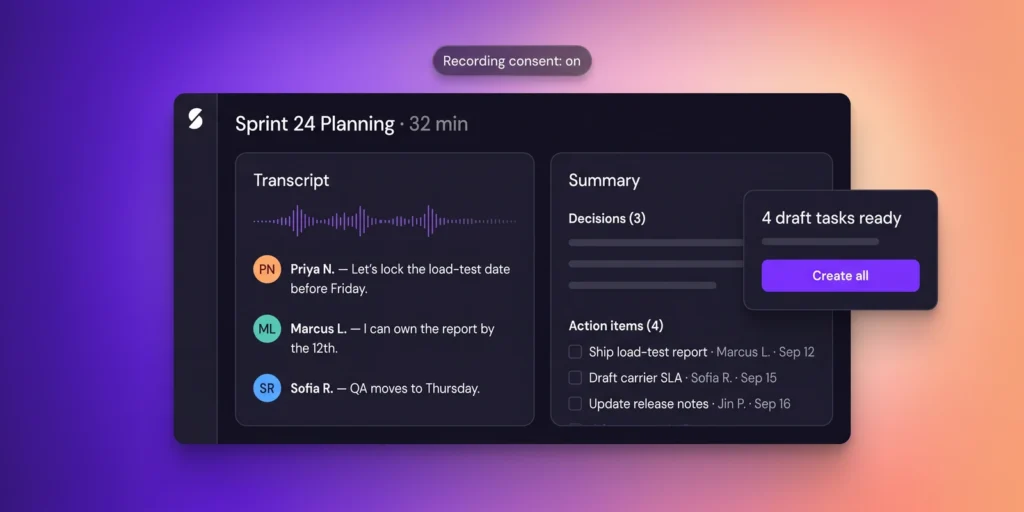
Meetings That End With Owners, Not Open Loops
- Engineering and product syncs: decisions and owners captured without a dedicated note-taker.
- Customer and partner calls: risks and commitments recorded with timestamps for follow-up.
- Recurring stand-ups and reviews: action items routed to the project linked to the calendar series.
- Leadership meetings: summaries delivered to the right channel or inbox under the same permissions.
- Distributed teams: transcripts in 30+ languages, so people who missed the call can catch up.
From Audio to Approved Tasks
- Capture: bot join or native recording import; an opted-out speaker’s audio is dropped before the transcript is stored.
- Transcribe: speech-to-text with per-segment language detection and speaker diarization in 30+ languages.
- Extract: decisions, action items, risks and open questions, each linked to a transcript timestamp.
- Draft: action items become draft tasks with a proposed owner and due date; ambiguous owners stay unassigned.
- Publish: the summary posts to the project, a channel or email, and the meeting.summarized webhook fires.
Key Capabilities
- Bot join or native recording import for Zoom, Google Meet and Microsoft Teams.
- Speaker diarization and transcription in 30+ languages, with searchable transcripts.
- Structured extraction of decisions, action items with owner and due date, risks and open questions.
- Draft tasks for one-click approval, created in the project linked to the meeting or calendar series.
- Summary delivery to the linked project, Slack or Microsoft Teams channels, or email.
- Timestamped citations from every summary item back to the transcript.
- Meeting notes available to Synapse Copilot when Knowledge Hub is enabled, under the same permissions.
- Risks and open questions carried into the linked project so they are not lost after the call.
Integrations, API & Limits
| Item | Detail |
|---|
| Conferencing | Zoom, Google Meet, Microsoft Teams |
| Calendars | Google and Microsoft calendars |
| Summary destinations | Linked project, Slack, Microsoft Teams, email |
| Transcript endpoint | GET /v1/meetings/{id}/transcript |
| Task creation on approval | POST /v1/tasks |
| Webhook | meeting.summarized (HMAC-SHA256 signed, automatic retries) |
| Languages | 30+, with speaker diarization |
| API rate limit | Team 300 · Business 1,000 · Enterprise 3,000 req/min (burst 2×) |
Consent, Retention & Security
- Configurable consent notice posted in the meeting chat, with per-participant opt-out.
- Separate admin-defined retention for audio and transcripts, including transcript-only policies.
- Permission-aware retrieval on transcripts, summaries and notes.
- Optional PII redaction before summarization.
- Encryption in transit (TLS 1.2+) and at rest (AES-256).
Availability & Pricing
| Plan | Included | Price (flat per workspace, EUR) |
|---|
| Starter | No | €10 / 1 month · €25 / 3 months · €45 / 6 months · €70 / 12 months (best value) |
| Team | Yes | €13 / 1 month · €35 / 3 months · €60 / 6 months · €100 / 12 months (best value) |
| Business | Yes | €15 / 1 month · €40 / 3 months · €70 / 6 months · €120 / 12 months (best value) |
| Enterprise | Yes | €20 / 1 month · €50 / 3 months · €85 / 6 months · €150 / 12 months (best value) |
Leave Every Meeting With Owners and Dates