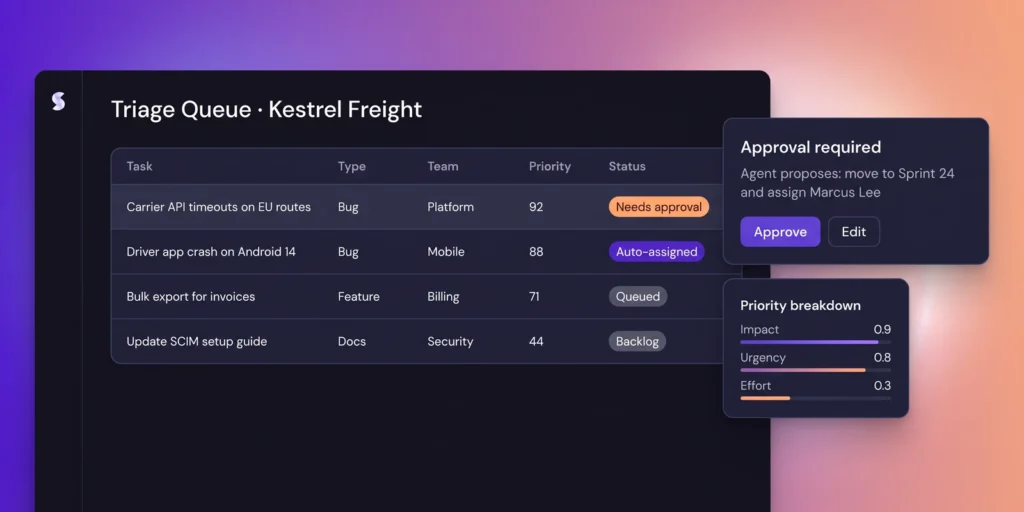
Stop Triaging by Hand. Keep Humans in Control.
- For engineering managers: a ranked queue each morning instead of an unsorted inbox of requests.
- For requesters: a visible status and priority rationale for every item they file.
- For product and operations leads: consistent prioritization rules across every team and channel.
- For admins: approval policies and audit logs that show exactly what agents proposed and changed.
How Triage Flows From Intake to Sprint
- Normalize: form, email, chat and issue payloads become draft tasks with source links and requester details.
- Classify: type, team and component are predicted with calibrated confidence; low-confidence items stay in the review queue.
- Deduplicate: embeddings are compared with open work, and similarity at or above 0.92 creates a merge suggestion for approval.
- Score: a weighted impact × urgency × effort score is computed, with every factor visible in the breakdown.
- Sequence: the dependency graph and critical path update, and the item is proposed for a cycle or backlog slot.
- Approve: gated changes wait for a human, are applied under the approver’s identity and fire the task.triaged webhook.
Key Capabilities
- Multi-channel intake from forms, email, Slack, Microsoft Teams, GitHub and Jira into one triage queue.
- Auto-classification by type, team and component, with per-field confidence calibrated against your team’s past corrections.
- Explainable priority scores; teams tune impact, urgency and effort weights to match how they make trade-offs.
- Duplicate detection via embedding similarity (default threshold 0.92, adjustable), with merges held behind an approval gate.
- Dependency graph with critical-path highlighting, so blockers on the longest chain surface first.
- Sprint auto-planning that respects real capacity from Resource & Capacity Planner when it is enabled.
- SLA timers and escalation rules that notify owners, leads or channels before a commitment is missed.
- Approval gates on reassignment and re-prioritization, set per action type and enforced by the API, not the interface.
Integrations, API & Limits
| Item | Detail |
|---|
| Intake sources | Forms, email, Slack, Microsoft Teams, GitHub, Jira |
| Create tasks | POST /v1/tasks |
| Triage suggestions | POST /v1/triage/suggestions (subject to your approval policy) |
| Webhook | task.triaged (HMAC-SHA256 signed, automatic retries) |
| Active tasks | Up to 25,000 per project |
| API rate limit | Team 300 · Business 1,000 · Enterprise 3,000 req/min (burst 2×) |
Security & Data Handling
- Agents act through scoped, short-lived API tokens, never standing credentials.
- Approval gates before any agent reassigns or re-prioritizes work.
- Every suggestion, approval and applied change logged with the actor, policy version and confidence at decision time.
- Optional PII redaction on intake content before it is sent to a model.
- Encryption in transit (TLS 1.2+) and at rest (AES-256).
Availability & Pricing
| Plan | Included | Price (flat per workspace, EUR) |
|---|
| Starter | No | €10 / 1 month · €25 / 3 months · €45 / 6 months · €70 / 12 months (best value) |
| Team | Yes | €13 / 1 month · €35 / 3 months · €60 / 6 months · €100 / 12 months (best value) |
| Business | Yes | €15 / 1 month · €40 / 3 months · €70 / 6 months · €120 / 12 months (best value) |
| Enterprise | Yes | €20 / 1 month · €50 / 3 months · €85 / 6 months · €150 / 12 months (best value) |
Ship From a Backlog That Triages Itself